

THIS PRODUCT IS DISCOUNTINUED. PLEASE CONTACT US FOR AVAILABILITY.
testo 350 S/XL 
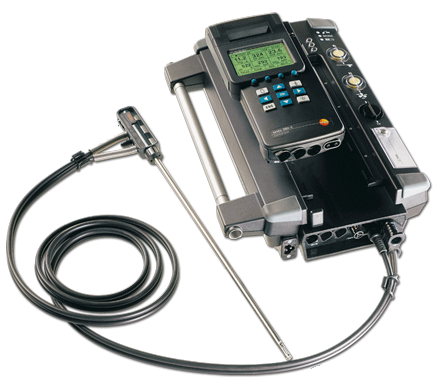 testo 350 is a flexible, portable analysis system which is basically made up of a control unit, a flue gas analyzer and a flue gas probe, depending on customer requirements.
The detachable control unit can control the analysis system and read out data. The testo 350 XL control unit can also be used as a separate hand-held analyzer for differential pressure (built-in) and also for temperature, humidity, flow etc. thanks to its additional probe socket. Readings are printed on the built-in printer .
THIS PRODUCT IS DISCOUNTINUED. PLEASE CONTACT US FOR AVAILABILITY.
The flue gas analyzer is the “heart” of the analysis system and is available in two different versions:
• testo 350 S Basic version
• testo 350 XL Advanced version.
The testo 3 350 S flue gas analyzer is equipped with a gas sensor for O2 as standard. One sensor must be fitted or up to 5 additional sensors for NO (option), NO2 (option), SO2 (option), NOlow (option), CO (Option), COlow (option), H2S (option), HC (Option) or CO2 via infrared gas sensor (option) can be fitted.
Temperature and differential pressure as well as the usual parameters such as ∆, qA, etc. are also calculated.
The even more convenient testo 350 X XL flue gas analyzer is equipped with gas sensors for O2, CO, NO and NO2 as standard. Additional sensors for HC (option), NOlow (option), COlow (option), SO2 (Option), H2S (option) or CO2 via infrared gas sensor (option) are available. In addition to the features of the S version, the testo 350 XL flue gas analyzer also has a Peltier gas preparation unit with a hose pump to regulate condensate disposal as well as a fresh air valve for long-term measurements lasting several hours.
Both versions of the flue gas analyzers can be equipped with up to 6 gas sensors, have a built-in rechargeable battery as standard, (for battery operation), data logger (250,000 readings) as well as a Testo data bus connection.
The testo 350 S flue gas analyzer can be retrofitted with all the features/functions of the testo 350 XL flue gas analyzer
Tests and permits
– TÜV Bayern RgG 211
– Conforms to DIN EN 50379 Part 2
KEY FEATURES
- Simultaneous gas and process analysis at different measurement points without a time-consuming measurement point changeover switch
- Option of connecting additional parameters such as °C; %RH; mA/mV etc.
- Bluetooth wireless transfer (optional)
- Flexibility of system in order to be able to react to the different requirements of the various systems. The testo 3 350 S S/XL measurement system fulfills these requirements. Several analyzer boxes, equipped differently, can be connected together, depending on the application. If several analyzer boxes, for example, are connected to the Testo data bus, they can be controlled, read out or programmed via the following two options:
- One a analyzer box a after the other via the testo 350 XL control unit, for example, or via the PC and an RS 232 cable
- Several flue gas a analyzers simultaneously via your PC and the Testo data bus controller with USB connection.
DOWNLOADS